Selling fast!
Get yours while you can.
Free Shipping on web orders over $50! (USA only. Some exclusions.) Our mid-season sale is on. Shop Phones
ISO-80
Couldn't load pickup availability
Prices valid in USA, Canada, and PR only.
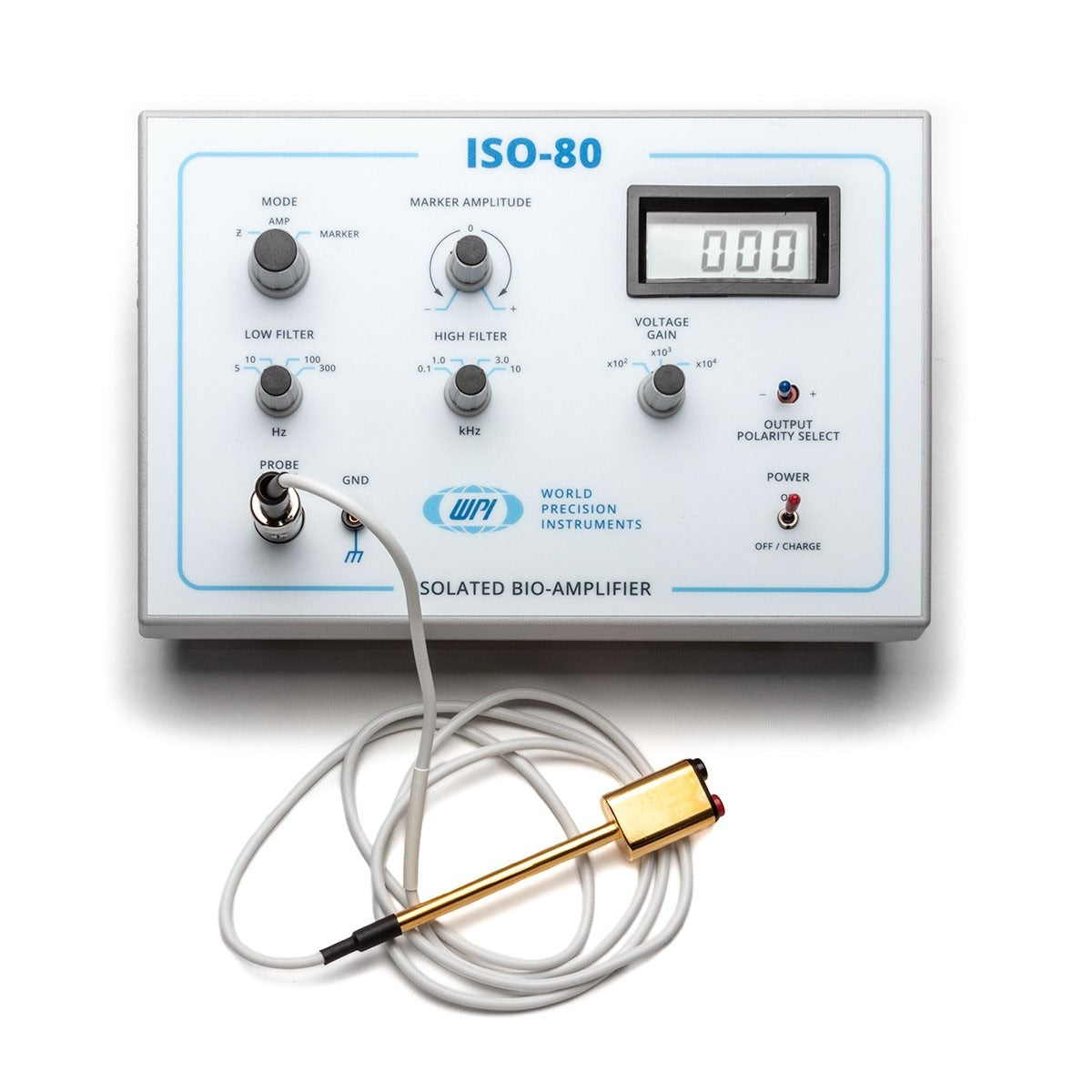
The ISO-80 provides low noise AC coupled amplification and offers excellent recording performance for monitoring extracellular nerve action potentials in vitro and in living animals. The ISO-80 is provided with a remote headstage (1 m cable) which incorporates an electrode impedance test function and a constant current stimulator. The constant current stimulator can be used for cell marking, stimulation or electrode cleaning. Typical applications include measuring EMG, EEG, extracellular and action potentials in vitro or in vivo. The ISO-80 system is DC isolated from the subject ground and employs state of the art electro-magnetic shielding for improved noise rejection. The amplifier employs both high pass and low pass filtering with gain from 100 to 10,000. The lowest low-pass setting is 5 Hz and the upper passband is 10 kHz.
To learn more about our warranty options, click here.
See what you need to know before you buy an amplifier.
The startup kit includes 2-CBL102, 2-5469, 2-13388, 3294, 2033, 2034, 2-2035, 2-M3301EH, 5470, EP1.
Included with the ISO-80 is a Startup Kit containing the following accessories needed for basic metal electrode electrophysiology research:
Mutliple applications are available with a variety of options. Here you can see two setups.
DIFFERENTIAL APPLICATION FOR METAL ELECTRODES
In this setup, metal electrodes are used with a differential amplifier. In this setup, a DAM80 is shown, but you could easily substitute a DAM50 (with 5489), ISO-DAM8A (with 74040) or ISO-80.


EXTRACELLULAR APPLICATIONS UTILIZING GLASS
For rare instances when using extracellular amplifiers with glass, you could use the setup shown below. In this setup, a DAM80 is shown, but you could easily substitute an ISODAM8A (with 74040) or ISO-80. Likewise, this setup shows the 2505 handle (1/4" - 6.3mm), but if you have a smaller micromanipulator, you may need the 5444 handle (3/16" - 4.8mm). In this illustration, MEH7W-10 is used, but any glass-size MEH7W could be used. (MEH7W-10 is 1.0mm glass, MEH7W-12 is 1.2mm glass, MEH7W-15 is 1.5mm glass and MEH7W-20 is 2.0mm glass.) EP2 is used for grounding in the illustration.
For single-ended applications, however, a 2033 wire adapter on the black connector socket can be connected to the 3294 cable. The tip used depends on your specific needs. In the illustration, TIP1TW1 was suggested. NOTE that the glass is not shown in the illustration below.


| Input Resistance | 1011Ω, Common Mode and differential |
| Input Leakage Current | 50 pA, max. |
| Amplification | x102, x103, x104 |
| Common Mode Rejection Ratio | 100 dB typ. @ 50/60 Hz |
| Equivalent Noise Signal Input | 0.4 µV rms (0.1-100 Hz) 2.0 µV rms (1 Hz - 10 kHz) |
| Filter Settings:Low frequency | 5, 10, 100, 300 Hz |
| Filter Settings:High frequency | 100 Hz, 1, 3, 10 kHz |
| Max. Output Voltage Swing | ±8 V |
| Electrode Impedance Range | 100 kΩ - 10 MΩ @ 300Hz |
| Stimulation Current | 0 to ±20 µA (constant current) |
| Maximum STIMULATION Voltage | ±15 V |
| Maximum Electrode Voltage | ±40 V |
| Displa y | 3.5-digit LCD |
| BATTERY TEST | Low battery display |
| Power | Two 9 V Ni-MH batteries & charger,supplied |
| SHIPPING WEIGHT | 4 lb. (1.8 kg) |

2033
5469
5470
13388
CBL102
M3301EH
Selling fast!
Get yours while you can.