Selling fast!
Get yours while you can.
Free Shipping on web orders over $50! (USA only. Some exclusions.) Our mid-season sale is on. Shop Phones
SYS-A385R
Couldn't load pickup availability
Prices valid in USA, Canada, and PR only.
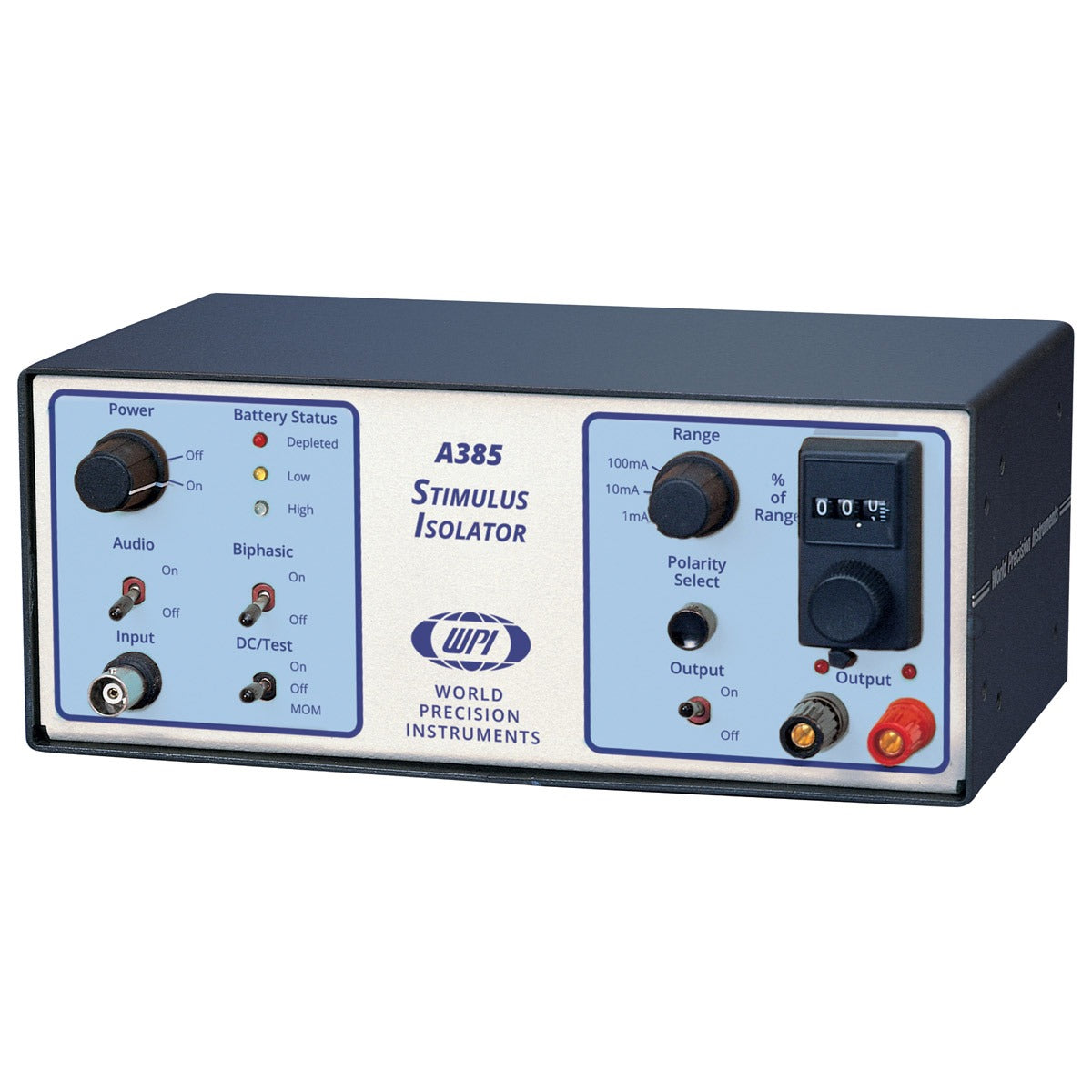
The A385 is an optically isolated current source, which can generate up to 100 mA of unipolar or biphasic constant current pulses or DC. Pulse duration is controlled manually or by an external 5V command. Output current amplitude is determined by a 3-digit 10-turn potentiometer. Maximum output voltage between the stimulating electrodes is +36V.
| Order code | Description | Battery Type | Includes Charger |
| A385RC | A385R with an A382 Battery Charger | Rechargeable Battery | Yes |
| SYS-A385R | High Current Isolator | Rechargeable Battery | No |
Benefits
Applications
The A385 is an optically isolated current source, which can generate up to 100 mA of unipolar or biphasic constant current pulses or DC. Pulse duration is controlled manually or by an external 5V command. Output current amplitude is determined by a 3-digit 10-turn potentiometer. Maximum output voltage between the stimulating electrodes is +36V.
For bipolar delivery, the polarity of the output can be toggled to the opposite polarity state with each successive pulse presented to the input. Pulse duration is controlled by an externally applied voltage. The input connector is a standard BNC, allowing TTL signals from a data acquisition system to be used.
The output amplitude is controlled by a 3-digit, ten-turn dial as a percentage of the range selected: for example, a setting of 45.6 in the 0-10 mA range translates to 4.56 mA at the output. Accuracy and repeatability are excellent. Designed for subcutaneous stimulation, maximum output voltage at the stimulating electrodes is 36 volts, reducing the possibility of accidental transcutaneous shocks. A compliance/output alarm sounds when the 36V limit is reached. Internal circuitry ensures electrodes are short-circuited during inactive periods (“electrode exhauster” feature). The A385 is not appropriate for transcutaneous stimulation.
The 1.2 amp-hour rating of the six heavy-duty lead-acid rechargeable batteries ensures that all day experiments will not be interrupted by dead batteries when charged daily. Indicator lights and audible alarms keep the user constantly apprised of the battery charge status. The batteries are recharged by the A382 System Charger, which is designed especially for the A385, and included with the A385RC.
NOTE: Not intended for human use.
| OUTPUT WAVEFORM | DC or current pulse |
| OUTPUT CURRENT RANGES | 1, 10, and 100 mA |
| CURRENT AMPLITUDE ERROR | 0.5% of full scale, max. |
| CURRENT RESOLUTION REPEATABILITY | 0.1% of full scale, typical |
| OUTPUT LOAD VOLTAGE EXCURSION (COMPLIANCE) | 36 V |
| EXTERNAL COMMAND VOLTAGE OUTPUT POLARITY CURRENT RISE TIME AND DELAY CURRENT FALL TIME AND DELAY OUTPUT TO GROUND RESISTANCE OPTOCOUPLER |
5 V at 3 mA minimum, 8.5 V maximum Reversible, manual switch or electronically switched bipolar delivery 6 μs, typical (1 KΩ load) 10 μs, typical (1 KΩ load) 1012 Ω 2500 V, rated minimum breakdown voltage |
| POWER | Six rechargeable lead-acid batteries (Requires companion charger A382) |
| DIMENSIONS | 8.5 x 3.5 x 5 in. (22 x 9 x 12 cm) |
| SHIPPING WEIGHT | 5 lb. (2.3 kg) |
Lin, C., Disterhoft, J., & Weiss, C. (2016). Whisker-signaled Eyeblink Classical Conditioning in Head-fixed Mice. Journal of Visualized Experiments, (109), e53310–e53310. https://doi.org/10.3791/53310
Pathak, D., Shields, L. Y., Mendelsohn, B. A., Haddad, D., Lin, W., Gerencser, A. A., … Nakamura, K. (2015). The Role of Mitochondrially Derived ATP in Synaptic Vesicle Recycling. Journal of Biological Chemistry, 290(37), 22325–22336. https://doi.org/10.1074/jbc.M115.656405
Pan, P.-Y., Marrs, J., & Ryan, T. A. (2015). Vesicular glutamate transporter 1 orchestrates recruitment of other synaptic vesicle cargo proteins during synaptic vesicle recycling. The Journal of Biological Chemistry, 290(37), 22593–22601. https://doi.org/10.1074/jbc.M115.651711
Zarzoso, M., Mironov, S., Guerrero-Serna, G., Willis, B. C., & Pandit, S. V. (2014). Ventricular remodelling in rabbits with sustained high-fat diet. Acta Physiologica, 211(1), 36–47. https://doi.org/10.1111/apha.12185
Pan, P.-Y., & Ryan, T. A. (2012). Calbindin controls release probability in ventral tegmental area dopamine neurons. Nature Neuroscience, 15(6), 813–815. https://doi.org/10.1038/nn.3099
Li, T., Finch, E. A., Graham, V., Zhang, Z.-S., Ding, J.-D., Burch, J., … Rosenberg, P. (2012). STIM1-Ca(2+) signaling is required for the hypertrophic growth of skeletal muscle in mice. Molecular and Cellular Biology, 32(15), 3009–3017. https://doi.org/10.1128/MCB.06599-11

5470
13347
Selling fast!
Get yours while you can.