Selling fast!
Get yours while you can.
Free Shipping on web orders over $50! (USA only. Some exclusions.) Our mid-season sale is on. Shop Phones
SU-P2000
Couldn't load pickup availability
Prices valid in USA, Canada, and PR only.
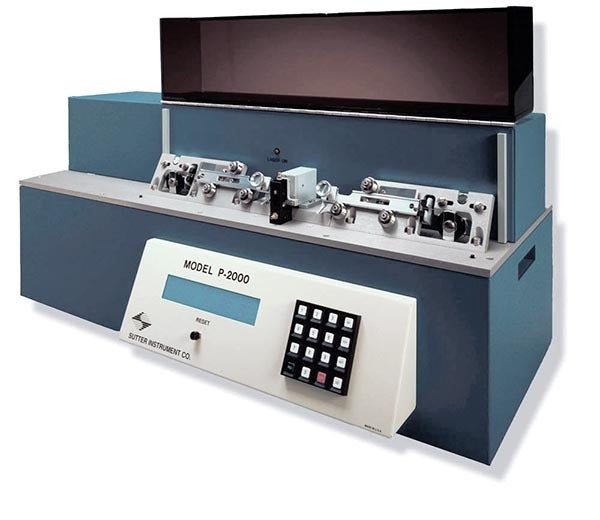
The SU-P2000 micropipette puller represents a significant advance in the technology of fabrication of micropipettes, optical fiber probes, and nanospray tips. The P-2000 integrates a CO2 laser-based heat source with the technology derived from our extensive experience with conventional pullers. This system offers capabilities unmatched by other pullers.
View our Micropipette Puller Comparison Chart
While the SU-P2000 is suitable for working with most conventional glasses, its primary advantage is the ability to work with quartz glass (fused silica). Quartz offers superior material properties for a variety of research applications. Quartz is stronger than other glasses and can facilitate penetration through tough tissues which would normally break conventional pipettes. For applications requiring a low noise glass, users will find that quartz is the lowest noise glass available. Quartz contains none of the metals used in conventional glasses. Optically, quartz is virtually free from fluorescence when illuminated.
A CO2 laser was selected as the heat source for the P-2000 for several reasons:
The SU-P2000 can store up to 100 separate programs, with each program consisting of up to 8 command lines. Programmable parameters include: laser power level, scan width, trip velocity, delay/ laser on time, and hard pull strength.
One important consideration for the use of the SU-P2000 is the diameter of the glass used. The SU-P2000 is designed to produce even heating on glass up to 1.2 mm in outside diameter. Larger diameter glass can be used with theSU-P20000 (up to 1.5 mm quartz and 1.8 mm conventional glass), but the performance is best with glass that is 1.2 mm diameter or less.
Micropipette Fabrication
Instructional Videos
Dimensions
30 x 14.25 x 13.25"
76 x 36 x 33.5 cm
Weight
90 lbs. (41 kg)
Electrical
115/230 V, 50/60 Hz
*Patent No.4,600,424
CLASS 1 LASER PRODUCT
Munoz, J.L. and Coles, J. Quartz micropipettes for intracellular voltage micro- electrodes and ion selective microelectrodes. Journal of Neuroscience Methods: 22:57-64, 1987.
Rae, J.L. and Levis, R. A. A method for exceptionally low noise single channel recordings. European Journal of Physiology - Pflügers Archiv: 420:618-620, 1992.
Zuazaga, C. and Steinacker, A. Patch-clamp recording of ion channels: Interfering effects of patch pipette glass. News in Physiological Science: 5:155-159, 1990.
Levis, R.A. and Rae, J. L. The use of quartz patch pipettes for low noise single channel recording. Biophysical Journal: 65:1666-1677, 1993.

$21,336.00
PUL-1000
SU-P2000F
World Precision Instruments' PUL-1000 is a microprocessor controlled, four-stage, horizontal puller for making glass micropipettes or microelectrodes used in intracellular recording, microperfusion and microinjection. It offers programmable sequences of up to four steps with complete control over the heating, force, movement and cooling time. This allows graduated cycles for a variety of applications. PUL-1000 can produce pipettes with tip diameters from less than 0.1µm to 10+ µm.
Crafting high-quality glass micropipettes is essential for precision work in microinjection, patch clamping, electrophysiology, and a wide range of microsurgical and research applications. WPI offers a complete suite of microforges, pullers, and bevelers designed to help researchers create consistent, reproducible pipette shapes tailored to their experimental needs. Whether you’re pressure-polishing patch-clamp pipettes, preparing multi-barrel assemblies, or measuring electrode impedance, the tools below provide reliable control, advanced programmability, and robust optical performance to support even the most demanding labs.
Below are some popular pullers from WPI, including Sutter pullers. Here we compare them so you can choose a system that is best suited for your application.
Pulling capillary glass into micropipettes or microelectrodes is a science and an art. Not only must you understand the environmental factors and the physics affecting each pull, but you must also know how to tweak your program to pull tips of consistent shape and size. Glass micropipettes or microelectrodes are used in intracellular recording, patch clamp, microperfusion, and microinjection. Let’s look at some factors that can affect the pulling of glass and how to adjust a program to get the micropipettes you need for your application.
Selling fast!
Get yours while you can.