

Selling fast!
Get yours while you can.
504220
Couldn't load pickup availability
Prices valid in USA, Canada, and PR only.

Watch as Gabe turns a binocular surgical microscope into a trinocular microscope and adds a video camera.

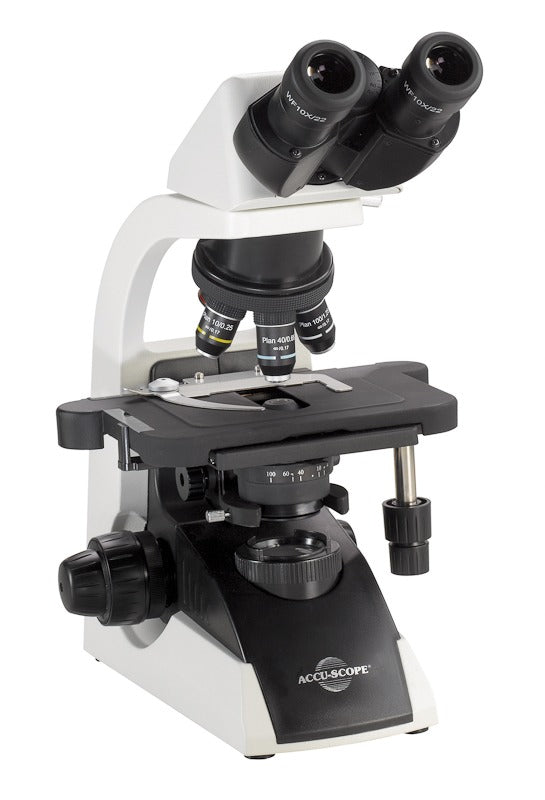
These instructions describe how to properly focus a binocular microscope.

It is common for a researcher to attach a camera to a microscope. Three types of cameras are available, and two are suitable for microscopy work:

A variety of microscope objectives are available. All objectives use lenses to focus light. Light is broken down into various wavelengths (colors) as it travels through a lens. The various wavelengths have different focal points. That means that red, green and blue appears to focus at different points. This is called chromatic aberration. Spherical aberrations are focal mismatches caused by the shape of the lens. Quality lenses are designed correct for chromatic and spherical aberration to bring the primary colors to a common focal point. These terms may help you determine the best objective for your application:

Microscopes are a standard laboratory tool, but purchasing the right microscope for a particular application can be a challenge. First, consider how you will use the instrument. Are you looking at slides, dissecting a small animal or performing a surgery? (The application dictates the necessary working distance and power of magnification.) What kind of a stand will you be using? (Boom stand, articulating arm or post stand) Will the microscope be used in a classroom setting? (A trinocular scope offers the option of including a camera.) Will you need a camera? (A camera allows you to project the microscope image on a PC or TV or to take still images.) The answers to these questions help you determine the required working distance, level of magnification, type of mounting stand and hardware required.