Selling fast!
Get yours while you can.
505980
Couldn't load pickup availability
Prices valid in USA, Canada, and PR only.
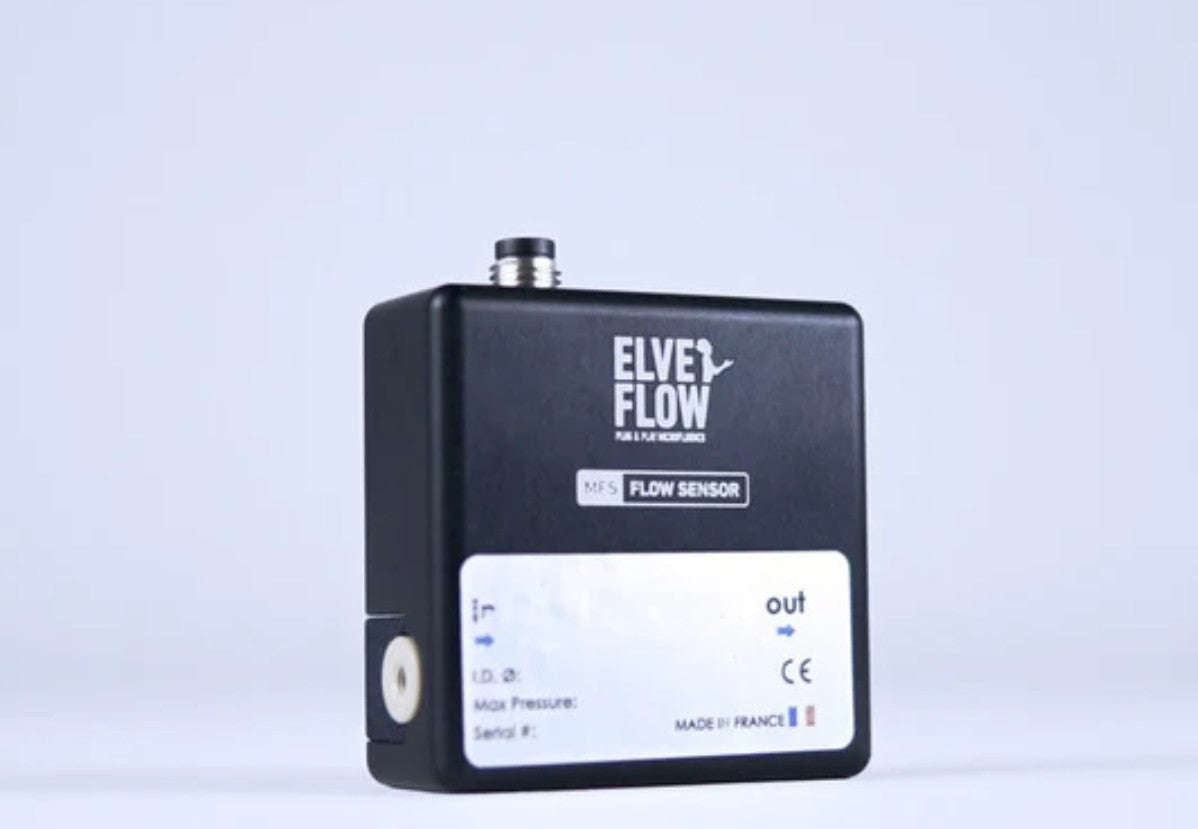
WPI introduces ElveFlow's line of water resistant digital microfluidic flow sensors (MFS+), offering a wide reading range of flow rates, from 7 nL/min to 40 mL/min (for water/water-like viscosities). The MFS+ line offers simplicity in flow rate monitoring and control for a variety of applications. The extreme accuracy of the MFS line makes these sensors a perfect solution to your microfluidic workflow. Ensure repeatability and quality results with the MFS microfluidic sensors. Pair with the Elveflow Pressure Sensor Reader and/or our Elveflow range of OB1 MK4Flow Controllers for ultimate precision in your microfluidic workflows.
| Order code | Elveflow Cross Reference SKU | Description |
| 505980 | MFS-D-1+ | Microfluidic Flow Sensor, Water Resistant, 0-1.5 µL/min |
| 505981 | MFS-D-2+ | Microfluidic Flow Sensor, Water Resistant, 0-7 µL/min |
| 505982 | MFS-D-3+ | Microfluidic Flow Sensor, Water Resistant, 0-80 µL/min |
| 505983 | MFS-D-4+ | Microfluidic Flow Sensor, Water Resistant, 0-1000 µL/min |
| 505984 | MFS-D-5+ | Microfluidic Flow Sensor, Water Resistant, 0-5 mL/min |
| 505985 | MFS-D-6+ | Microfluidic Flow Sensor, Water Resistant, 0-40 mL/min *ONLY compatible with Elveflow's updated OB1 MK4 series and V3 Sensor Reador (MSR3) |
WPI introduces Elveflow’s line of standard Microfluidic Flow Rate Digital Sensors (MFS), using thermal technology to measure flow rates within micro-channels. Features of the MFS line make for reliable and accurate microfluidic applications.
You can achieve total flow control of your experiment by combining any Microfluidic Flow Sensor (MFS) with WPI-offered ElveFlow pressure controller systems within the OB1 line.
*The Elveflow ESI software automatically adjusts the pressure to reach the required flow rate.
Researchers who want to monitor the flow rate of a third-party instrument (ie. a syringe pump) can plug any of the MFS flow sensors into the 505889 Microfluidic Sensor Reader (MSR).

All of our ElveFlow flow controller systems offered such as the OB1 series pumps can be coupled with the Microfluidic Flow Sensors (MFS) series. Using the feedback loop control of ElveFlow's ESI software, you can accurately monitor and control flow rates in your microfluidic setup in a stable, pulseless and responsive fashion. Directly input the desired flow rates into the software to acheive the requested flow rate parameters.
*Note: he microfluidic flow sensors can be plugged anywhere inline in your microfluidic setup.
Microfluidic Flow Sensor User Guide
MFS: Setting a Flow Control Feedback Loop Quick Guide
MFS Flow Rate Ranges & Accuracy: How to Choose
BFS & MPS Flow Controller Comparison Chart
MFS Datasheet
Free ESI Software & SDK Libraries
*ESI Software: Windows 8 and 10 both 32 and 64 bit versions, are supported
Thanks to an intuitive interface, the Elveflow® Smart Interface allows you to use Elveflow® instruments from the simplest commands, for beginners to the most complex manipulations for experts.
Software features beneficial for use alongside the MFS microfluidic flow sensors:

A microfluidic Coriolis flow sensor contains a U-shaped loop which constantly vibrates. When a fluid flows through this vibrating loop, Coriolis forces are generated and bend or twist the tube. The extremely small tube displacements are detected by sensors and fed to the electronic board. Since the measured phase shift is proportional to the mass flow, the Coriolis flow rate sensor measures the mass flow directly. This measurement principle is very accurate, fast and, more importantly, independent of the properties of the fluid (density, temperature, viscosity, pressure, heat-capacity or conductivity).

Q: Can I use the flow rate sensor with any type of solution?
A: As long as your solution is chemically compatible with the wetted materials (glass and PEEK for MFS1 to 5 and PPS, stainless steel and epoxy-based adhesive for MFS6), you can use your MFS Flow Sensor with any type of liquids. All MFS Flow Sensors are calibrated to be used with water and IPA except MFS1 and MFS5 that come only with water calibration. The IPA calibration makes the sensor easily compatible with most of oils. If you wish to use other types of solutions, it is possible calibrate your sensor using our ESI software.
Q: What do I need to control the flow rate in my microfluidic chips?
A: Using Elveflow equipment supplied by WPI, you can measure, as well as precisely control the flow rate. First of all, you need a pressure source and a pressure regulator to control the pressure. Then, you need a reservoir where you can store your liquid and pressurize it. Finally, you need tubing to connect the reservoir to the connect the reservoir to the pressure controller, the flow sensor and the microfluidic chip. WPI and Elveflow microfluidics specialists work jointly and can propose a complete starting kit adapted to the needs of your application.
Q: Is it possible to use the Flow Rate sensor without the pressure controller?
A: Microfluidic flow sensors with a 4-port Microfluidic Sensor Reader can be provided to allow you to monitor up to 4 flow sensors using Elveflow ESI software. You can also integrate the sensor measurement into your system using ElveFlow's Software Development Kit (SDK), available for C++/Python/MATLAB and LabVIEW programming.