


Selling fast!
Get yours while you can.
ENDOHM-6G
Couldn't load pickup availability
Prices valid in USA, Canada, and PR only.
To find the equivalent EndOhm chambers compatible with EVOM3 or EVOM™ Manual, visit the product page here.
| Order Code | Description |
| ENDOHM-24G-SNAP | EndOhm for 24mm and Costar Snapwell Culture Cups (6 wells per plate) |
| ENDOHM-12G | EndOhm for 12mm Culture Cups (12 wells per plate) |
| ENDOHM-6G | EndOhm for 6mm Culture Cups (24 wells per plate) |


Using WPI’s EVOM2 resistance meter, Endohm chambers provide reproducible resistance measurements of endothelial and epithelial monolayers in culture cups. Transfer cups from their culture wells to the Endohm chamber for measurement rather than using hand-held electrodes. The chamber and the cap each contain a pair of concentric electrodes: a voltage-sensing silver/silver chloride pellet in the center plus an annular current electrode. The height of the top electrode can be adjusted to fit cell culture cups of different manufacture.
Make more precise measurements with Endohms
Endohm’s symmetrically opposing circular disc electrodes, situated above and beneath the membrane, allow a more uniform current density to flow across the membrane than with STX2 electrodes. The background resistance of a blank insert is reduced from 150 Ω (when using WPI’s hand-held STX2 electrodes) to less than 5 Ω. With Endohm’s fixed electrode geometry, variation of readings on a given sample is reduced from 10-30 Ω with STX2 electrodes (depending on the experience of the user) to 1-2 Ω. Compared with other resistance measurement methods, Endohm with EVOM2™ offers a much more convenient and economic solution to “leaky tissue” measurement. Because of the uniform density of the AC square wave current from EVOM2, errors owing to electrode polarization or membrane capacitance are largely eliminated. Endohm together with EVOM2 offers the most accurate and economical endothelial ohmmeter now available. To date, cups from Corning, Millipore, Nunc, Greiner and BD Falcon have been tested. Endohm chambers may be sterilized with EtO, alcohol or a bactericide; not autoclavable.
NOTE: EndOhm chambers have Ag/AgCl electrodes. If you are measuring for extended periods of time, you should consider any potential cytotoxic issue from long term exposure to silver to your cells.
The ENDOHM-6G is compatible with the following chambers:
| Corning | Millipore | Material | Membrane Diameter (mm) | Growth Surface Area (cm²) | Membrane Pore Size (μm) |
| 3470 | 6.5 | 0.33 | 0.4 | ||
| 3472 | PITP01250 | 6.5 | 0.33 | 3.0 | |
| 3413 | PCF Insert | 6.5 | 0.33 | 0.4 | |
| 3415 | PITP 01250 PCF Insert |
6.5 | 0.33 | 3.0 | |
| 3421 | 6.5 | 0.33 | 5.0 | ||
| 3422 | PIEP 01250 PCF Insert |
6.5 | 0.33 | 8.0 | |
| 3495 | PIHT12R48* PET Insert |
6.5 | 0.33 | 0.4 | |
| PIHA012 50 | HA Insert | 6.5 | 0.33 | 0.45 | |
| PICM012 50 | CM Insert | 6.5 | 0.33 | 0.4 | |
| 3496 | PISP12R48* PET Insert |
6.5 | 0.33 | 3.0 | |
| PIRP12R48* PET Insert |
6.5 | 0.33 | 1.0 | ||
| PIMP12R48* PET Insert |
6.5 | 0.33 | 5.0 | ||
| PIEP12R48* PET Insert |
6.5 | 0.33 | 8.0 | ||
| PIXP01250 PCF Insert |
6.5 | 0.33 | 12 | ||
| PIHP01250 | 1.0 | ||||
| PITT01250 | 3.0 |
* The tri-supports overhang the chamber edge and the well cannot be held parallel to the electrodes.
| Nunc | Pore size (μm) | Culture area (cm²) |
| 140620 | 0.4 | 0.47 |
| 140627 | 3.0 | 0.47 |
| 140629 | 8.0 | 0.47 |
| ThinCertTM | Membrane material | Pore size [µm] | Pore density [cm-2] | Optical membrane properties | TC surface treatment/Sterile | Multiwell plates/ThinCertTM per box |
| 662640 | PET | 0.4 | 1 x 10⁸ | translucent | +/+ | 2/48 |
| 662641 | PET | 0.4 | 2 x 10⁶ | transparent | +/+ | 2/48 |
| 662610 | PET | 1.0 | 2 x 10⁶ | transparent | +/+ | 2/48 |
| 662630 | PET | 3.0 | 0.6 x 10⁶ | transparent | +/+ | 2/48 |
| 662631 | PET | 3.0 | 2 x 10⁶ | translucent | +/+ | 2/48 |
| 662638 | PET | 8.0 | 0.15 x 10⁶ | translucent | +/+ | 2/48 |
| Millicell | Pore size (μm) | Qty/pk |
| MCHT24H48 | 0.4 | 48 |
| MCRP24H48 | 1.0 | 48 |
| MCSP24H48 | 3.0 | 48 |
| MCMP24H48 | 5.0 | 48 |
| MCEP24H48 | 8.0 | 48 |
| BD Falcon | Membrane material | Pore size [µm] | Pore density [cm-2] | Optical membrane properties | TC plate (#wells) |
| 353095 | PET | 0.4 | 2.0 ± 0.2 x 10⁶ | transparent | 24 |
| 353104 | PET | 1.0 | 1.6 ± 0.6 x 10⁶ | transparent | 24 |
| 353096 | PET | 3.0 | 8 ± 2 x 10⁵ | transparent | 24 |
| 353097 | PET | 8.0 | 6 ± 2 x 10⁴ | translucent | 24 |
| 353495 | PET | 0.4HD | 100 ± 10 x 106 | translucent | 24 |
| 353492 | PET | 3.0HD | 2.0 ± 0.2 x 10⁵ | translucent | 24 |
The ENDOHM-12G is compatible with the following chambers:
| Corning | Millipore | Membrane Diameter (mm) | Growth Surface Area (cm²) | Membrane Pore Size (μm) |
| 3401 | 12 | 1.12 | 0.4 | |
| 3402 | PITP01250 | 12 | 1.12 | 3.0 |
| PITT01250 | 12 | 1.12 | 3.0 | |
| 3493 | 12 | 1.12 | 0.4 | |
| 3494 | 12 | 1.12 | 3.0 | |
| 3460 | PIHT15R48* PET Insert |
12 | 1.12 | 0.4 |
| PIRP15R48* PET Insert |
12 | 1.12 | 1.0 | |
| 3462 | PISP15R48* PET Insert |
12 | 1.12 | 3.0 |
| PIMP15R48* PET Insert |
12 | 1.12 | 5.0 | |
|
PIEP30R48* PIEP15R48* PET Insert |
12 | 1.12 | 8.0 |
* The tri-supports legs must be balance correctly so that the filter is parallel to the electrodes.
| Nunc | Pore size (μm) | Culture area (cm²) |
| 140652 | 0.4 | 1.13 |
| 140654 | 3.0 | 1.13 |
| 140656 | 8.0 | 1.13 |
| ThinCertTM | Membrane material | Pore size [µm] | Pore density [cm-2] | Optical membrane properties | TC surface treatment/Sterile | Multiwell plates/ThinCertTM per box |
| 665640 | PET | 0.4 | 1 x 10⁸ | translucent | +/+ | 4/48 |
| 665641 | PET | 0.4 | 2 x 10⁶ | transparent | +/+ | 4/48 |
| 665610 | PET | 1.0 | 2 x 10⁶ | transparent | +/+ | 4/48 |
| 665630 | PET | 3.0 | 0.6 x 10⁶ | transparent | +/+ | 4/48 |
| 665631 | PET | 3.0 | 2 x 10⁶ | translucent | +/+ | 4/48 |
| 665638 | PET | 8.0 | 0.15 x 10⁶ | translucent | +/+ | 4/48 |
| Millicell | Pore size (μm) | Qty/pk |
| MCHT12H48 | 0.4 | 48 |
| MCRP12H48 | 1.0 | 48 |
| MCSP12H48 | 3.0 | 48 |
| MCMP12H48 | 5.0 | 48 |
| MCEP12H48 | 8.0 | 48 |
| BD Falcon | Membrane material | Pore size [µm] | Pore density [cm-2] | Optical membrane properties | TC plate (#wells) |
| 353180 | PET | 0.4 | 2.0 ± 0.2 x 10⁶ | transparent | 12 |
| 353103 | PET | 1.0 | 1.6 ± 0.6 x 10⁶ | transparent | 12 |
| 353181 | PET | 3.0 | 8 ± 2 x 10⁵ | transparent | 12 |
| 353182 | PET | 8.0 | 6 ± 2 x 10⁴ | translucent | 12 |
| 353494 | PET | 0.4HD | 100 ± 10 x 106 | translucent | 12 |
| 353292 | PET | 3.0HD | 2.0 ± 0.2 x 10⁵ | translucent | 12 |
The ENDOHM-24SNAP is compatible with the following chambers:
| Corning | Millipore | Membrane Material | Pore Size (µm) |
| 3407 | Polycarbonate | 0.4 | |
| 3801 | Polycarbonate | 0.4 | |
| Polycarbonate | 3.0 | ||
| 3412 | PIHT30R48* | Polycarbonate | 0.4 |
| 3414 | Polycarbonate | 3.0 | |
| PITT03050 | Polycarbonate | 3.0 | |
| 3428 | Polycarbonate | 8.0 | |
| 3450 | Polyester | 0.4 | |
| 3452 | Polyester | 3.0 | |
| 3491 | Collagen | 0.4 | |
| 3492 | Collagen | 3.0 | |
| PICMORG50 | Organotypic Insert | 0.4 | |
| PIHA03050 | HA Insert | 0.45 | |
| PIHP03050 | PCF Insert | 0.4 | |
| PICM03050 | HA mixed cellulose esters | 0.4 | |
| PIHT30R48* | PET Insert | 0.4 | |
| PIRP30R48* | PET Insert | 1.0 | |
| PISP30R48* | PET Insert | 3.0 | |
| PIMP30R48* | PET Insert | 5.0 | |
| PIEP30R48* | PET Insert | 8.0 |
* The tri-support legs must be balanced correctly so that the filter is parallel to the electrodes.
| Nunc | Pore size (μm) | Culture area (cm²) |
| 140640 | 0.4 | 3.14 |
| 140642 | 3.0 | 3.14 |
| 140644 | 8.0 | 3.14 |
| 140660 | 0.4 | 4.1 |
| 140663 | 3 | 4.1 |
| 140668 | 8 | 4.1 |
| ThinCertTM | Membrane material | Pore size [µm] | Pore density [cm-2] | Optical membrane properties | TC surface treatment/Sterile | Multiwell plates/ThinCertTM per box |
| 657640 | PET | 0.4 | 1 x 10⁸ | translucent | +/+ | 4/24 |
| 657641 | PET | 0.4 | 2 x 10⁶ | transparent | +/+ | 4/24 |
| 657610 | PET | 1.0 | 2 x 10⁶ | transparent | +/+ | 4/24 |
| 657630 | PET | 3.0 | 0.6 x 10⁶ | transparent | +/+ | 4/24 |
| 657631 | PET | 3.0 | 2 x 10⁶ | translucent | +/+ | 4/24 |
| 657638 | PET | 8.0 | 0.15 x 10⁶ | translucent | +/+ | 4/24 |
| Millicell | Pore size (μm) | Qty/pk |
| MCHT06H48 | 0.4 | 48 |
| MCRP06H48 | 1.0 | 48 |
| MCSP06H48 | 3.0 | 48 |
| MCMP06H48 | 5.0 | 48 |
| MCEP06H48 | 8.0 | 48 |
| BD Falcon | Membrane material | Pore size [µm] | Pore density [cm-2] | Optical membrane properties | TC plate (#wells) |
| 353090 | PET | 0.4 | 2.0 ± 0.2 x 10⁶ | transparent | 6 |
| 353102 | PET | 1.0 | 1.6 ± 0.6 x 10⁶ | transparent | 6 |
| 353091 | PET | 3.0 | 8 ± 2 x 10⁵ | transparent | 6 |
| 353093 | PET | 8.0 | 6 ± 2 x 10⁴ | translucent | 6 |
| 353493 | PET | 0.4HD | 100 ± 10 x 106 | translucent | 6 |
| 353092 | PET | 3.0HD | 2.0 ± 0.2 x 10⁵ | translucent | 6 |


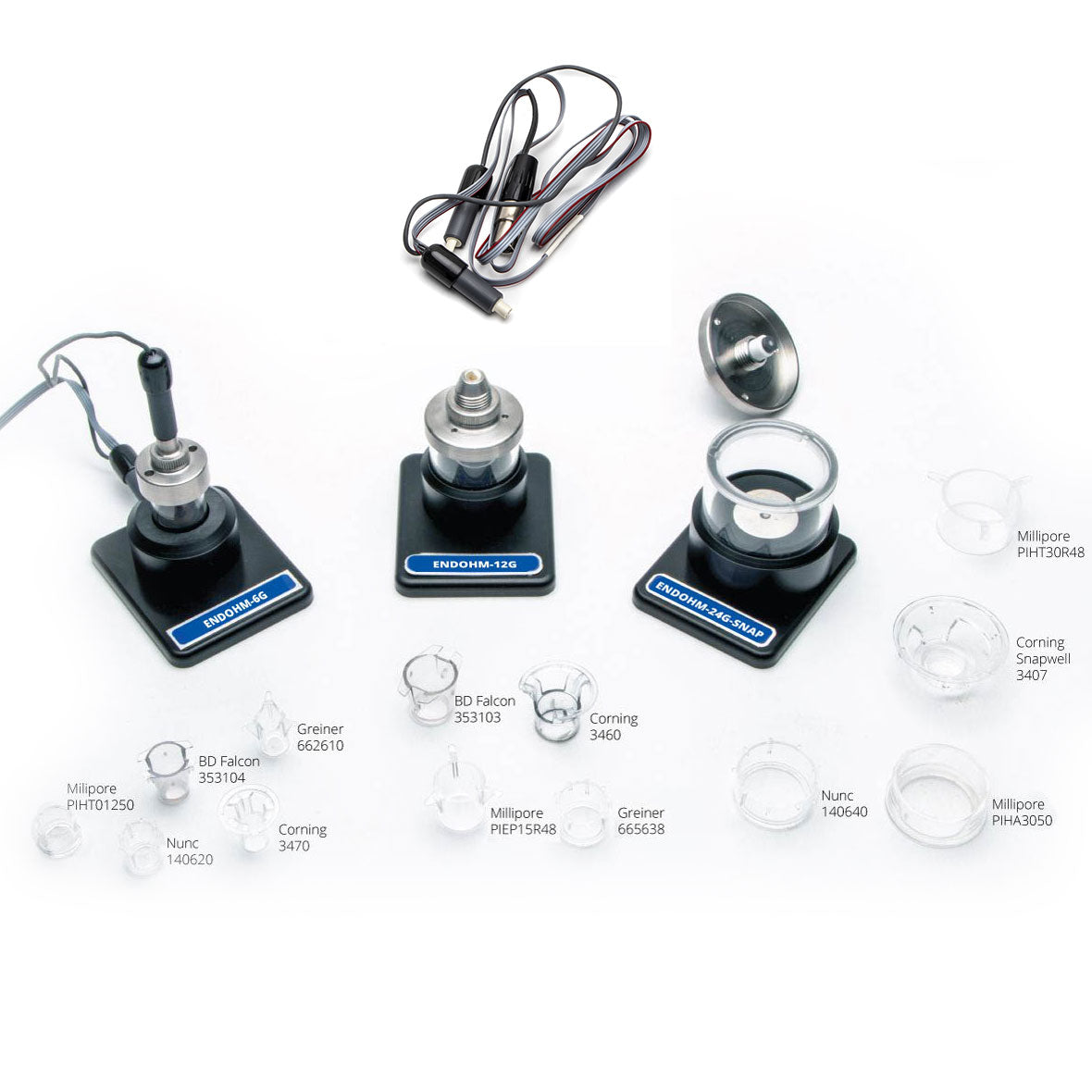


The EndOhm series of chambers, when used with WPI’s EVOM2 resistance meter or the Millicell ERS, are designed to provide reproducible and accurate resistance measurements of endothelial tissue in culture cups. Resistance values obtained with the EndOhm are consistent with those obtained using a well-designed Ussing Chamber.

EVOM™ Auto is the latest generation of WPI’s automated transepithelial or transendothelial electrical resistance (TEER) measurement system. Using the same proven technology in the EVOM™ Manual and REMS, combined with a new multi-electrode array, software interface and control system, it delivers our fastest workflow solution while improving TEER measurement accuracy:

In 2022, the United States Food and Drug Administration (FDA) approved 37 new drugs, of which 20 were chemical entities and 17 were biologics. In 2023, drug discovery remains strong with many new advancements a result of changing landscapes in both the types of drugs that are being developed and the new and innovative assay that are being launched to evaluate drugs preclinically. Therapeutic development is still highly focused on diseases that affect large populations of people for which there are lack of effective treatments, with 2023’s most anticipated drug launches expected to be in areas of cancer, Alzheimer’s disease, cardiovascular disease, and ulcerative colitis.

In 2022, the United States Food and Drug Administration (FDA) approved 37 new drugs, of which 20 were chemical entities and 17 were biologics. In 2023, drug discovery remains strong with many new advancements a result of changing landscapes in both the types of drugs that are being developed and the new and innovative assay that are being launched to evaluate drugs preclinically. Therapeutic development is still highly focused on diseases that affect large populations of people for which there are lack of effective treatments, with 2023’s most anticipated drug launches expected to be in areas of cancer, Alzheimer’s disease, cardiovascular disease, and ulcerative colitis.

Transepithelial Electrical Resistance (TEER) is a widely used technique in the life sciences fields and therapeutic development. It measures the electrical resistance across a cell monolayer, providing information about the integrity and functionality of epithelial barriers. TEER has proven to be a valuable tool in various fields, including drug absorption studies, tissue engineering, and disease modeling. This article aims to explore the benefits of TEER and its applications in different research areas.

Transepithelial/transendothelial electrical resistance (TEER) measurement is one of the most used practices to evaluate cellular health, such as cellular confluence, barrier integrity, or barrier function of cellular monolayers grown onto multiwells. The TEER measurement using WPI’s Epithelial Voltohmmeter (EVOM) is considered the gold standard because of its reliable measurements and numerous literature citations using various cell types. The EVOM™ Manual and EVOM™ Auto along with different choices of electrodes (STX4, STX HTS high throughput screening, EndOhm chambers, and multielectrode array for EVOM™ Auto) allow researchers to perform and analyze cell samples in 6, 12, and 24 removable inserts and 24 and 96 HTS multiwell plate formats. The major challenges researchers may encounter while performing studies to capture TEER measurement include:
· Unstable read outs
· Out of range values
· Inconsistent measurements among sample replicates or batches.
Consider the following factors to overcome any TEER measurement problems and obtain accurate and reliable measurements.