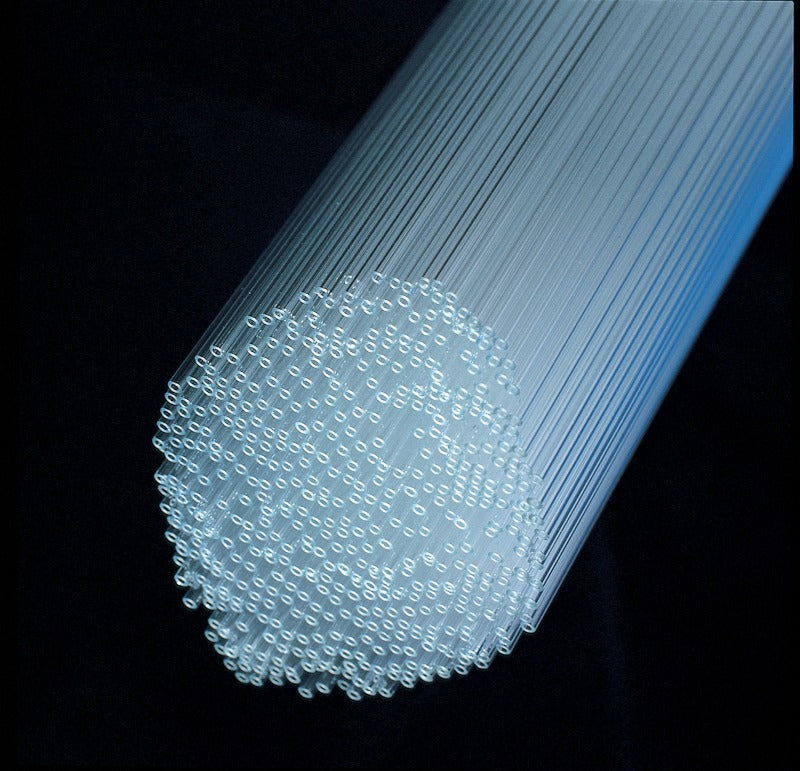
Evaluated for best softening temperature, electrical properties, sealability, leachable components
Features
- Softening point for patch clamp glass is 720°C
- 4" Long
- OD/ID Tolerance: ±0.1 mm
- Length Tolerance: ±1 mm
- Quantity: 100 per vial
- Recommended to use with Glass Handling Forceps (77020)
- Products supplied non-sterile
Options
Soda Lime glass with a Dialectic Constant of 7.2
| Order code |
OD/ID
|
| PG-AR150-4 |
Soda-lime 1.5/0.75 mm
|
| PG-AR165-4 |
Soda-lime 1.65/1.1 mm
|
Glass Capillary Properties
PG52151-4 and PG52165-4 are prepared from Schott #8250 glass (equivalent to Corning #7052), one of the most widely used patch clamping glasses. This is a specially formulated borosilicate glass with a softening temperature that is 110°C lower than regular borosilicate glass (Corning 7740, or Pyrex). It has excellent sealing properties for most cells. Electrical properties are also very good.
Patch clamp capillaries do not have microfilaments.
Softening Temperature
The softening temperature determines how easily each glass type can be pulled to the desired shape and the extent to which it can be heat polished. Glass with a high softening temperature is difficult to pull and causes unnecessary wear on the heating element of the puller. This makes it very hard to make electrodes that are reproducible and of consistent quality. Patch clamp glass with a low softening temperature is preferred; however, higher softening temperature glass is stronger.
Electrical Properties
Electrical properties determine how much noise the glass capillary is likely to produce in recording situations. The lower the product of dielectric constant times the loss factor, the smaller the equivalent noise current the glass will produce (Rae and Levis, Methods in Enzymology, 207, p67, 1992). Patch clamp glass with good electrical properties is critical especially in single-channel recording.
Sealability
It is not clear what factors determine the sealing ability of the patch to the glass. Almost any glass can form a gigohm seal under the right conditions. Different glass types vary, however, in how easily they form a seal. It is important to select a patch clamp glass that seals easily. Good fire polish is critical for seal.
Leachable Components
Leachable components: Substances leached from glass can alter channel behavior. Since different channels are sensitive to different glass components, it is best to record one type of channel with several different kinds of pipette glass to eliminate any artifact due to the glass.