
DriRef Reference Electrodes
Low electrolyte leakage, stable potential with low resistance.
Features
- Extremely low electrolyte leakage
- Stable, reproducible potential with low resistance
- Chemically resistant to strong acids and bases
Benefits
- May be used with ion selective electrodes without contamination from the reference electrode
Applications
- Small volume, low salt concentration measurement (SDR)
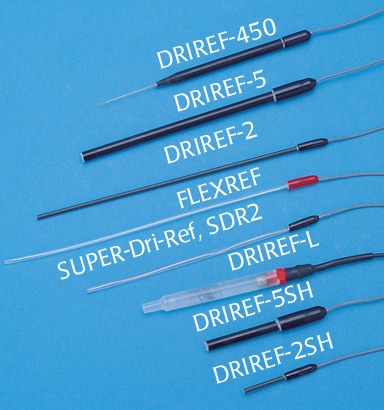
Dri-Ref™ Electrodes
Dri-Ref reference electrodes were developed by WPI to have extremely low electrolyte leakage properties, hence the name “Dri-Ref.” In addition to this key feature, these electrodes exhibit stable and reproducible potential and low resistance. Stored in KCl when not in use, they have a long life expectancy. Low leakage is achieved by using KONBO™, a product combining modern ceramic and conductive polymer technology, as the liquid junction. Electrode resistance is low, an important consideration when making low-noise measurements.
Although the internal filling solution contains KCI, the low fluid leakage means Dri-Ref may be used in combination with ion selective electrodes, including those for K+ and Cl-, without significant contamination from the reference electrode.
The Dri-Ref electrodes are chemically resistant to strong acids and alkalines. Dri-Ref electrodes are not suitable for use in organic solvents. In addition, the long, thin FLEXREF may be easily manipulated to accommodate a difficult experimental setup.
SUPER-Dri-Ref
With a diameter of 2-mm, SUPER-Dri-Ref does not leak electrolyte at all. Exhibiting the electrical stability of a classic flowing junction reference cell, this electrode exhibits low resistance and a stable half-cell potential essentially independent of sample electrolyte concentration. SUPER-Dri-Ref is ideal for small volume and low salt concentration measurements.
Micro-Reference Electrode
Only 450µm in diameter and 1inch long, WPI’s new DRIREF-450 reference electrode can be used along with other sensors in space-restricted areas and very small sample volumes.
Luer-Tip Reference
The male luer fitting at the front of the DRIREF-L allows it to be easily connected to a female luer port (see WPI’s luer fittings) to form a tight seal — a very convenient installation for a flow-through system.
Comparison Chart of DriRef Specifications
| Electrode | Length | Diameter | Construction | Lead Length | Connector | Resistance (typical) | Filling Solution | Electrolyte Leakage (mL/hr) |
|---|---|---|---|---|---|---|---|---|
| DRIREF-450 | 2.54cm | 450µm | Coated Glass | 30 in. (76cm) | 2mm pin | < 5KΩ | KCl | — |
| DRIREF-5 | 9cm | 4.7mm | Epoxy | 30 in. (76cm) | 2mm pin | ~500Ω | KCl | > ~7.4×10⁻⁷ |
| DRIREF-2 | 13cm | 2mm | Isoplast™ | 30 in. (76cm) | 2mm pin | ~2.7KΩ | KCl | ~5.7×10⁻⁸ |
| FLEXREF | 13cm | 1.5 mm | Teflon™ | 30 in. (76cm) | 2mm pin | ~2.7KΩ | KCl | ~5.7×10⁻⁸ |
| SDR2 | 9cm | 2 mm | PVC | 30 in. (76cm) | 2mm pin | < 5KΩ | KCl | — |
| DRIREF-L | 7.5cm | Standard Luer | Polypropylene | 30 in. (76cm) | 2mm pin | ~500Ω | KCl | ~7.4×10⁻⁷ |
| DRIREF-5SH | 3.5cm | 4.7mm | Epoxy | 30 in. (76cm) | 2mm pin | ~500Ω | KCl | ~7.4×10⁻⁷ |
| DRIREF-2SH | 2cm | 2 mm | Isoplast™ | 30 in. (76cm) | 2mm pin | ~2.7KΩ | KCl | ~5.7×10⁻⁸ |
-


Super Dri-Ref Reference Electrode
SDR2
Regular price $219Sale price $219 Regular priceUnit price per -
-

Dri-Ref Reference Electrode with Luer Tip
DRIREF-L
Regular price $264Sale price $264 Regular priceUnit price per -

Dri-Ref Reference Electrode, 4.7 mm (short)
DRIREF-5SH
Regular price $161Sale price $161 Regular priceUnit price per -

Dri-Ref Reference Electrode, 4.7 mm
DRIREF-5
Regular price $161Sale price $161 Regular priceUnit price per -


Micro Dri-Ref Reference Electrode
DRIREF-450
Regular price $484Sale price $484 Regular priceUnit price per -

Dri-Ref Reference Electrode, Short
DRIREF-2SH
Regular price $158Sale price $158 Regular priceUnit price per -

Dri-Ref Reference Electrode, 2 mm
DRIREF-2
Regular price $158Sale price $158 Regular priceUnit price per


